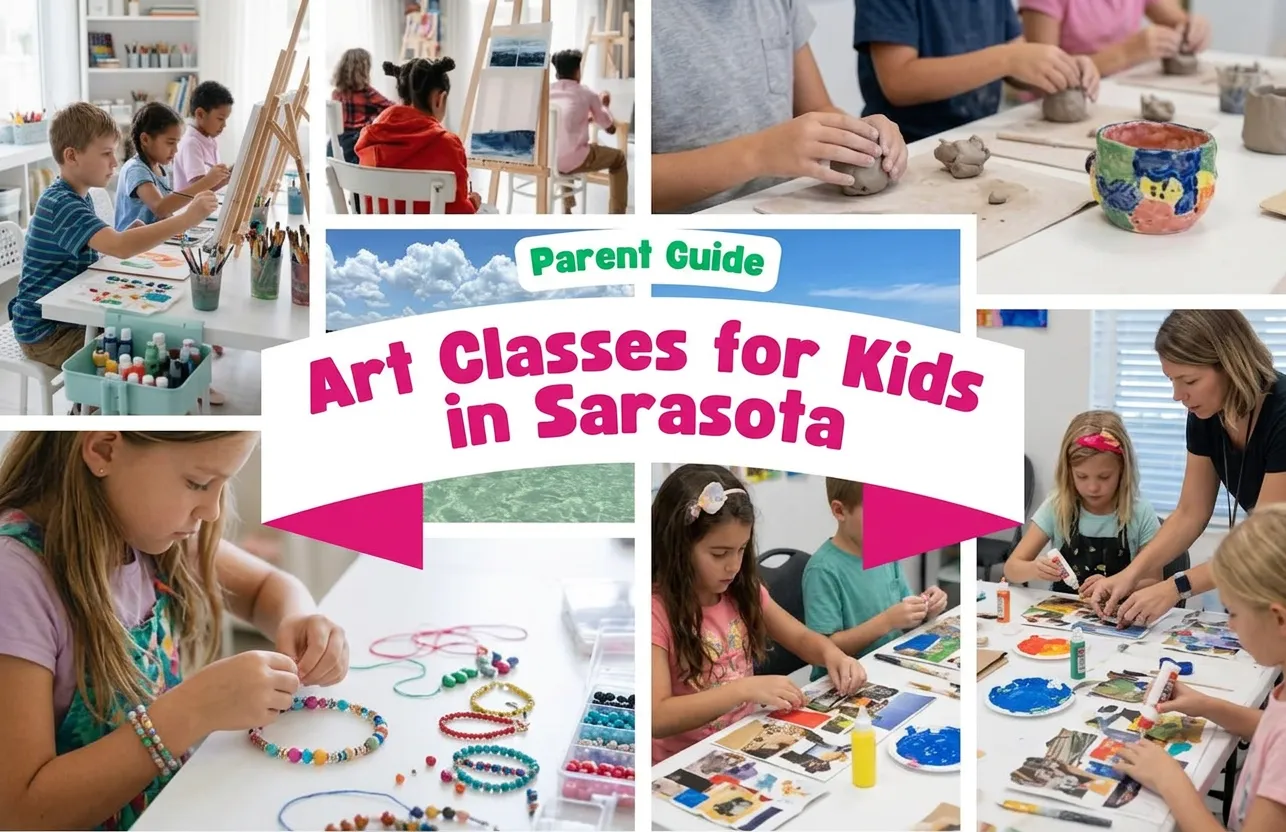
Art classes for kids in Sarasota are offered through independent studios, museum programs, after-school enrichment providers, and weekend workshops, covering drawing, painting, ceramics, textile arts, and mixed media. That variety is welcome, but it also makes comparison harder. Knowing what to look for before you sign up saves most families from a round of trial-and-error.
This guide is organized around the questions that actually matter: class size, teaching approach, age fit, and what your child walks away with. It's not a ranking of every provider in the area. For a broader look at creative summer programs, see best art and creative summer camps in Sarasota. For a comparison of after-school options across all categories, see best after-school activities in Sarasota. This guide is specifically for parents trying to evaluate whether a particular art class is worth enrolling in.
Whether your child is brand new to drawing and painting or has been filling sketchbooks for years, the class structure matters more than the curriculum.
What a Good Kids Art Class Actually Looks Like
The biggest mistake parents make is choosing based on what the class teaches (watercolor, ceramics, drawing) rather than how it's taught. A technically impressive curriculum delivered in a group of 25 kids with minimal individual attention isn't going to move the needle for most children.
Research from Americans for the Arts documents that meaningful arts participation, where kids get regular feedback and room to experiment, builds confidence and critical thinking skills that transfer well beyond the art room. The emphasis is on regular and meaningful: a one-off workshop won't do much, but a consistent weekly class with an attentive instructor can.
A few things that separate a good program from a mediocre one:
- Small groups. Once a class gets above 12 to 15 kids, the instructor can't give real feedback to each student. Look for studios that cap enrollment or explicitly advertise small class sizes.
- Age-appropriate pacing. A seven-year-old and a twelve-year-old have very different fine motor skills and attention spans. Classes that group too wide an age range often pitch everything to the middle and leave both ends frustrated.
- Supplies included. When families have to source their own materials, beginners often show up with the wrong things and spend the first session catching up. Included supplies also lower the barrier to trying the class in the first place.
- Freedom to experiment alongside instruction. The best art classes for kids aren't just technique demos. Kids need room to make choices, make mistakes, and develop their own preferences.
A Quick Evaluation Framework
Use this when comparing programs. You don't need to fill out every cell. Three or four clear answers are usually enough to know whether a class is a fit.
| What to Ask | Why It Matters |
|---|---|
| How many kids per class? | Over 15 means less individual attention and slower feedback |
| What's the age range? | Tight ranges (2-3 years) mean better-matched projects and pacing |
| Are supplies included? | Affects real cost and reduces beginner friction |
| How long is each session? | Under 45 minutes is often too short for creative flow; over 2 hours can be draining for younger kids |
| What happens if my child falls behind or wants to go faster? | Good programs have a plan; vague answers are a yellow flag |
| Can we try a class before committing? | Trial classes or drop-in options signal confidence in the product |
| Is this project-based or skill-based? | Neither is wrong, but knowing helps you match to your child's learning style |
What Kids Actually Develop in Art Classes
Parents often describe the goal as "keeping kids creative," which is real and valid. But the practical skills that show up in other areas of life are worth naming.
Fine motor control develops naturally through drawing, cutting, painting, and working with small tools. For younger kids especially, this has direct connections to handwriting and focus tasks.
Sequencing and planning. Any project that takes more than one session requires kids to hold a process in mind: what comes first, what has to dry before the next step, what they'd do differently. This kind of thinking maps directly onto project-based work in school.
Tolerance for imperfection. Art class is one of the few environments where there's no wrong answer, but there are still results to evaluate. Kids who make art regularly tend to get more comfortable trying things that might not work.
Self-direction. In a good class, the instructor is a resource, not the source of all decisions. Kids learn to make choices and own them.
These aren't guarantees, and they depend heavily on the quality of the class. A rigid, follow-the-steps-exactly program produces different outcomes than one that leaves room for individual expression.
What to Know About Sarasota's Art Education Scene
Sarasota has a genuinely strong arts culture for a city this size, partly because of institutions like the Ringling College of Art and Design and the Ringling Museum. Sarasota's arts institutions also give families more ways to encounter visual arts outside of weekly classes.
Programs worth researching include those offered through local museums, independent studios, and enrichment-focused after-school providers. For a broader comparison across those categories, the best after-school activities guide lists providers across all types of enrichment. For summer-specific programs in the arts, the creative summer camps guide covers options focused on that season.
Sarasota neighborhoods with the heaviest concentration of kids' enrichment programs include downtown Sarasota, the South Trail corridor, and Lakewood Ranch, with additional options scattered through Siesta Key, Gulf Gate, and University Park.
Sewista Studio's Kids Art Classes in Sarasota
Sewista Studio at 2015 S Tuttle Ave in Sarasota teaches sewing, textile arts, and creative design for kids ages 7 and up. It's a useful example of what a well-structured small-group program looks like in practice.
Classes cap at 10 students. Every session is hands-on, and all supplies are provided. The curriculum is skill-based with room for individual creative choices: kids learn real techniques and apply them to projects they've chosen or co-designed. There are weekly classes, weekday homeschool classes, seasonal camps, and private lessons.
Sewista draws families from Sarasota, Lakewood Ranch, Siesta Key, University Park, Gulf Gate, Palmer Ranch, and Bradenton.
"I wasn't sure my daughter would stick with it, but she's been coming for two years now. She plans her projects ahead of time and has started helping younger kids in the class. It's been more than I expected from an art class."
If sewing and textile design sound like a fit for your child, browse current classes.
Frequently Asked Questions
What age is the right age to start art classes?
Most structured art programs start around age 5 to 6, though the right fit depends more on the child than the age. If your child can focus on a task for 20 to 30 minutes and follow basic multi-step instructions, they're likely ready. For ages 7 and up, options expand significantly, including programs that tackle more complex techniques and multi-session projects.
How do I know if a class is too advanced for my child?
Ask the instructor directly. A good program will have an honest conversation about skill level and either reassure you, suggest starting with a beginner session, or offer a trial class. If the answer is vague or dismissive, that tells you something.
Project-based or skill-based? Which is better?
That depends on your child. Project-based classes tend to be more motivating for kids who want to make something they're proud of. Skill-based classes build technique more systematically, which some kids find satisfying and others find tedious. Some programs blend both, which often works well.
How often should kids attend to see real progress?
Once a week is the most common cadence for kids' enrichment classes, and it's generally enough to see development over a semester. Twice a week accelerates progress. Drop-in or monthly classes are fine for exposure but usually don't build skills in a lasting way.
What if my child tries it and doesn't like it?
It happens. Ask upfront about refund and withdrawal policies, especially for longer commitments. A good program won't lock you into a semester with no exit. Starting with a shorter session or a camp before committing to weekly classes is a reasonable way to test fit.
Are Sarasota art classes available year-round?
Many studios run year-round with breaks around major holidays. Others follow a semester model with fall, spring, and summer sessions. It's worth asking whether the program pauses in summer or transitions to a camp format, since that affects scheduling for school-year families.
If your child is drawn to sewing, fashion, and making wearable objects specifically, the kids fashion design classes guide goes deeper on what to look for in programs focused on construction and design. For broader schedule planning, the homeschool enrichment guide covers how families in the area build weekly creative routines. For summer specifically, the indoor summer camps guide covers heat-friendly options when school is out.
If your child is ready for a hands-on creative class, browse Sewista's current class schedule.